

Matcha in cosmetics: more than a visual trend
Matcha in cosmetics is moving from a visual trend to a serious product development direction.
Its recognizable green colour creates an immediate connection with wellness and mindful daily rituals. However, its potential reaches beyond product aesthetics. Matcha contains catechins, polyphenols, caffeine, L-theanine and chlorophyll. Its best-studied component is epigallocatechin gallate, usually known as EGCG. EGCG is associated with antioxidant and soothing activity. Therefore, it has become especially relevant to skincare concepts focused on environmental stress and visible fatigue.
For beauty brands, matcha creates an opportunity to combine botanical inspiration with modern cosmetic science. At the same time, the final performance depends on the selected raw material and formula.
What is matcha?
Matcha is produced from finely ground leaves of Camellia sinensis.
Unlike a traditional green tea infusion, matcha uses the whole powdered leaf. Before harvesting, the tea plants are shaded. This process influences their chemical profile and characteristic green colour.
Matcha naturally contains:
- catechins and other polyphenols,
- caffeine,
- L-theanine,
- chlorophyll,
- flavonoids,
- selected vitamins and minerals.
However, its composition may vary between suppliers and production batches. Cultivation, harvest conditions and processing methods can all influence the final raw material.
Therefore, the word “matcha” on an ingredient list does not guarantee a specific concentration of active catechins.
More information about its composition can be found in this scientific review of matcha green tea.
Why is matcha in cosmetics gaining attention?
Consumers increasingly expect botanical ingredients to offer more than attractive storytelling. They want credible benefits, effective formulas and sensorial products. Matcha fits these expectations because it is already associated with balance, wellness and daily reset rituals.
In skincare, this identity can support concepts developed for:
- dull and tired-looking skin,
- environmental stress,
- visible redness,
- excess sebum,
- uneven texture,
- weakened skin comfort.
Moreover, matcha has a strong visual identity. Its colour can influence the formula, packaging and entire campaign concept.
However, brands should distinguish between matcha powder, green tea extract and isolated EGCG. Although they come from the same plant, they do not offer identical performance.
The potential benefits of matcha in cosmetics
Antioxidant support
Antioxidant activity is the best-known benefit associated with green tea.
Every day, the skin is exposed to ultraviolet radiation, pollution and other environmental stressors. These factors can contribute to reactive oxygen species and oxidative stress. Green tea catechins, particularly EGCG, may help neutralize reactive oxygen species. They may also support the skin’s natural antioxidant response. As a result, matcha-inspired ingredients can complement formulas developed for stressed or dull-looking skin. However, they do not replace sunscreen, retinoids or well-stabilized vitamin C. Instead, they work best as complementary antioxidant ingredients.
A recent review of green tea catechins and skin health discusses their antioxidant and skin-supporting potential.
Soothing and anti-inflammatory potential
Oxidative stress and inflammation are closely connected.
Research suggests that EGCG may influence inflammatory pathways, including NF-κB and AP-1. In cosmetic products, this may support formulas designed for visibly stressed or reactive skin. Therefore, green tea-derived ingredients can be relevant to products for temporary redness and discomfort. Nevertheless, the complete formula remains important. Fragrance, exfoliating acids and preservatives can all influence product tolerance.
For this reason, a soothing matcha formula should also contain barrier-supporting or calming ingredients.
Support for oily and blemish-prone skin
Green tea extracts have also been explored in products for oily skin.
Small studies suggest that topical Camellia sinensis extracts may help control excess sebum. Importantly, this effect was observed without excessive dryness in selected research. EGCG is also studied for its sebostatic and anti-inflammatory potential. Consequently, matcha in cosmetics can be relevant to lightweight gels, serums and cleansers. These formats suit combination and oily skin particularly well.
However, matcha should not be presented as an acne treatment. Cosmetic communication should focus on balance, sebum control and clearer-looking skin.
Support against visible photoageing
Ultraviolet radiation contributes to oxidative stress and premature skin ageing.
It can also stimulate matrix metalloproteinases. These enzymes are involved in the degradation of collagen and other structural components. Laboratory research suggests that EGCG may help limit selected processes associated with UV-induced damage. Small human studies have also reported improvements in some skin parameters. Still, the evidence is less extensive than for retinoids or vitamin C.
Therefore, green tea works best as a supporting antioxidant. It can complement sunscreen and other well-established actives.
Matcha powder, green tea extract or EGCG?
These ingredients are often presented as interchangeable. In practice, each option has different strengths and limitations.
Matcha powder
Matcha powder contains the whole ground leaf. It offers recognizable colour, botanical storytelling and a natural sensorial identity. For this reason, it can be effective in masks, cleansers and powder-based products. However, its composition is not always standardized.
It may also create sediment, uneven dispersion or colour transfer. Therefore, it can be more challenging in leave-on serums and creams.
Standardized green tea extract
Standardized green tea extract gives formulators better control over polyphenol content. It is generally easier to use in gels, serums and emulsions. Moreover, it can provide greater consistency between production batches. For many beauty brands, it offers the best balance between performance and botanical positioning.
Isolated EGCG
EGCG is the most extensively studied catechin found in green tea. It provides a clearer connection with available scientific research. However, it is also sensitive to oxygen, light, heat and unsuitable pH.
As a result, EGCG requires careful stabilization and suitable packaging.
Why formulation matters in matcha cosmetics
The performance of matcha in cosmetics depends on more than the ingredient list.
Catechins may degrade when exposed to light, oxygen, heat or metal ions. Unsuitable pH conditions can also reduce their stability.
Therefore, formulators may use:
- controlled pH,
- chelating agents,
- compatible co-antioxidants,
- encapsulation systems,
- protective packaging.
For example, opaque packaging can reduce exposure to light. Airless pumps can also help limit contact with oxygen. Delivery systems may further improve ingredient protection and interaction with the skin. These can include liposomes, microcarriers or other encapsulation technologies. Combining several antioxidants does not automatically improve a formula. Every interaction must be evaluated within the finished product.
Stability, compatibility and efficacy testing remain essential.
Why matcha offers an opportunity for beauty brands
Matcha connects several important directions in cosmetic development.
First, it fits wellness-led beauty and ritual-based skincare. In addition, its visual identity works well across packaging and social media.
It can also inspire products in several categories, including:
- antioxidant serums,
- gentle cleansers,
- barrier creams,
- targeted boosters,
- wash-off masks,
- powder-to-paste formats.
Successful concepts should not depend on one trending ingredient alone. The formula, texture and application method must support the wider product story. As a result, the collection becomes more credible and commercially relevant.
For private label brands, matcha in cosmetics can provide both scientific and emotional value.
Introducing Matcha Reset Ritual
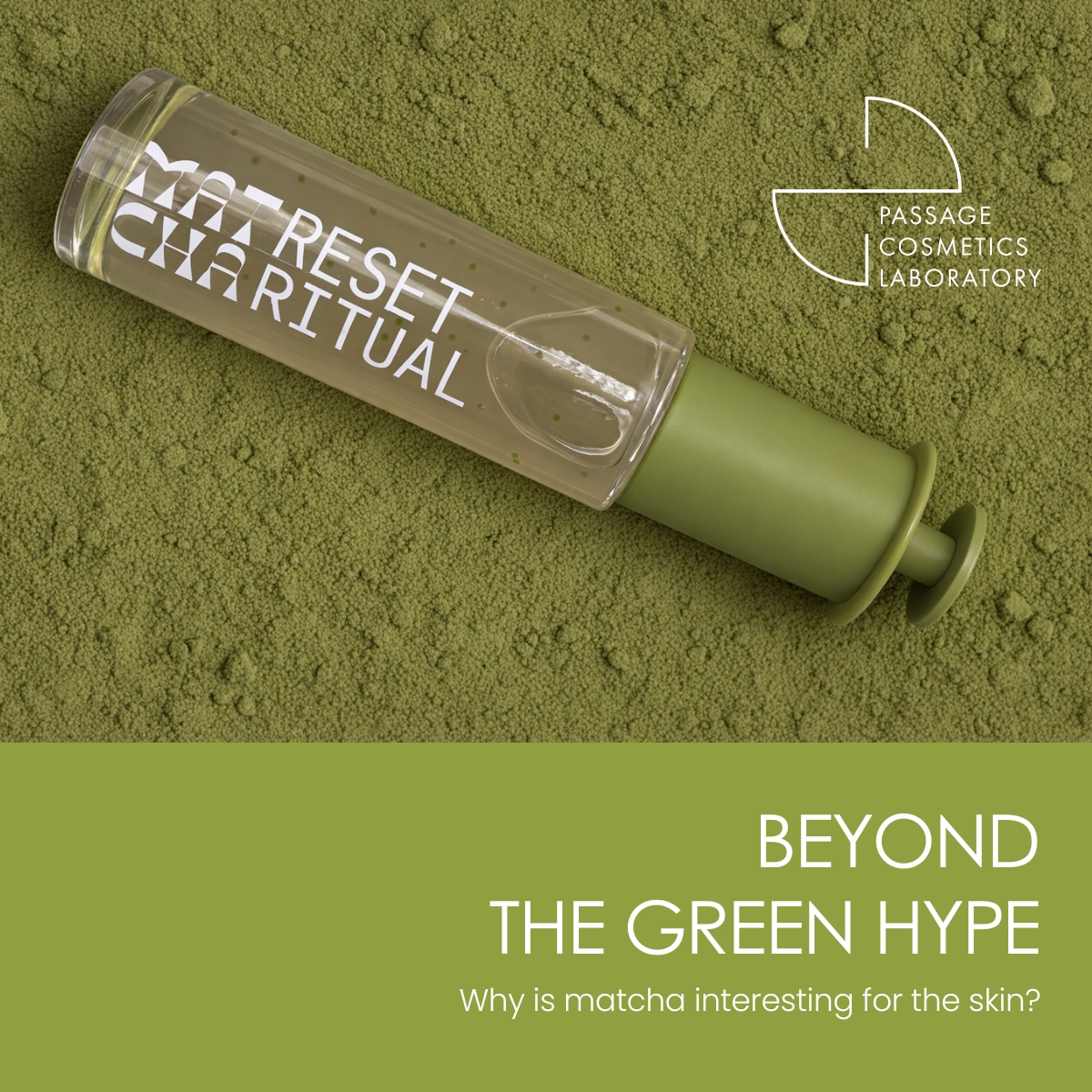
Passage Cosmetics Laboratory developed Matcha Reset Ritual as a complete four-step skincare concept.
The collection combines matcha-inspired storytelling with modern textures and targeted product formats. Each step has a specific role within the routine.
Together, the products create a coherent ritual focused on renewal, recovery and skin comfort.
Day 1: The Reset
The Reset Resurfacing Gel begins the routine.
It helps remove accumulated dead skin cells and improve the appearance of uneven texture. Its fresh gel texture creates a sensorial first step.
This stage prepares the skin for the products used on the following days.
Day 2: The Renewal
The Renewal Serum focuses on hydration and revitalization.
Its lightweight formula contains visible microcapsules. Therefore, it combines skincare performance with an engaging product experience.
The serum supports smoother, firmer and more rested-looking skin.
Day 3: The Recovery
The Recovery Barrier Cream provides the comforting stage of the ritual.
Its soft, whipped texture supports skin hydration and comfort. Barrier-focused ingredients help leave the skin feeling balanced and protected.
Importantly, the collection does not focus only on exfoliation. Recovery is also essential to a balanced skincare routine.
Day 4: The Precision Dot
The Precision Dot Booster completes the ritual.
Its targeted applicator allows the formula to be placed exactly where additional care is needed. This creates a distinctive and easy-to-understand application method.
In addition, the dot format has strong visual potential for digital campaigns and consumer education.
More than a green skincare collection
Matcha Reset Ritual was developed as a complete concept rather than unrelated individual products. Each product has a distinct texture, function and application method. At the same time, all four products share one recognizable visual identity.
The concept may inspire:
- a complete skincare range,
- selected hero products,
- a limited-edition launch,
- a wellness-led seasonal collection.
Formulas and packaging can also be adapted to a brand’s positioning and target market.
Private label matcha cosmetics with Passage
Passage Cosmetics Laboratory S.A. is a private label cosmetics manufacturer based in Poland. As an OEM and ODM cosmetics partner, we support beauty brands throughout the development process.
Our services include:
- cosmetic concept development,
- formulation,
- packaging selection,
- manufacturing and filling,
- quality control,
- preparation of market-ready product collections.
Our approach combines laboratory expertise with trend research and product storytelling. Concepts such as Matcha Reset Ritual show how a recognizable trend can become a coherent cosmetic range. Brands can use the collection as inspiration for further private label development.
Develop matcha in cosmetics for your brand
Matcha offers more than a recognizable green colour. With the right formula, it can support a credible skincare concept focused on antioxidant care, balance and skin comfort.
Are you exploring matcha in cosmetics or another trend-led direction for your brand?
Discover Matcha Reset Ritual and contact our team to discuss private label, OEM or ODM cosmetic development.
Contact: [email protected]
Developed and manufactured in Poland.
Frequently asked questions
What are the benefits of matcha in cosmetics?
Matcha contains catechins and polyphenols associated with antioxidant and soothing activity.
Green tea-derived ingredients may support skin exposed to oxidative stress. They may also complement products for oily or visibly stressed skin.
Is matcha powder the same as green tea extract?
No.
Matcha powder contains the whole ground leaf. Green tea extract is processed to concentrate selected compounds.
A standardized extract usually offers greater consistency in leave-on cosmetic formulas.
What is EGCG in skincare?
EGCG is one of the most extensively studied green tea catechins.
It is valued for its antioxidant and anti-inflammatory potential. However, it requires protection from light, oxygen and unsuitable pH.
Can matcha replace sunscreen?
No.
Matcha, green tea extract and EGCG do not replace broad-spectrum sunscreen. Instead, they may complement an antioxidant skincare routine.
Can Matcha Reset Ritual be developed as a private label collection?
Yes.
Matcha Reset Ritual can inspire a private label or OEM/ODM cosmetic project. The formulas, packaging and final product range can be adapted to the brand.